
Recovery from shoulder replacement surgery takes 4 to 6 months for most daily activities, and 9 to 12 months to reach full strength and functional use. Physical therapy begins within the first few days of surgery and continues through formal outpatient rehab for 3 to 4 months. Reverse shoulder replacement typically allows earlier active movement than anatomic total shoulder replacement, though full recovery timelines are similar.
One of our patients at Intecore had bilateral hip replacements years ago, rehabbed both of them with us, and went on to snow ski and water ski without limitation. Then in 2024 he came back for a right shoulder replacement. In 2025, a left shoulder replacement. He trusted the same team for all four procedures — and he is doing well.
That kind of outcome does not happen by accident. It takes good surgery, good rehabilitation, and a patient who shows up and does the work. Shoulder replacement recovery is demanding — the shoulder is one of the most complex joints in the body, and getting it fully functional again after a replacement requires patience, consistency, and a well-structured plan.
If you have a shoulder replacement scheduled, or you have recently had one, this guide is for you. I want to give you a realistic picture of what the recovery looks like, what physical therapy involves at each stage, and what you can do to give yourself the best chance of a full, strong recovery.
Table of Contents
Total Shoulder Replacement vs Reverse Shoulder Replacement: What Is the Difference?
Understanding which procedure you have had matters, because the recovery differs in important ways.
Anatomic Total Shoulder Replacement
The ball of the upper arm (humeral head) is replaced with a metal ball, and the socket (glenoid) is resurfaced with a plastic component. This restores the natural anatomy of the joint. It is typically performed when the rotator cuff is intact and the primary problem is arthritis or joint damage. Recovery involves careful protection of the repaired soft tissue in the early weeks before strengthening can begin.
Reverse Total Shoulder Replacement
In a reverse shoulder replacement, the ball and socket positions are swapped — a metal ball is fixed to the shoulder blade and a socket is attached to the upper arm. This design allows the deltoid muscle to power the shoulder when the rotator cuff is damaged or absent, which is why it is commonly used in patients with severe rotator cuff arthropathy. The recovery from a reverse replacement typically allows earlier active movement, though the full timeline to strength and function is similar.
Knowing which procedure you had helps your PT structure your rehabilitation protocol correctly from day one.
When Does Physical Therapy Start After Shoulder Replacement?
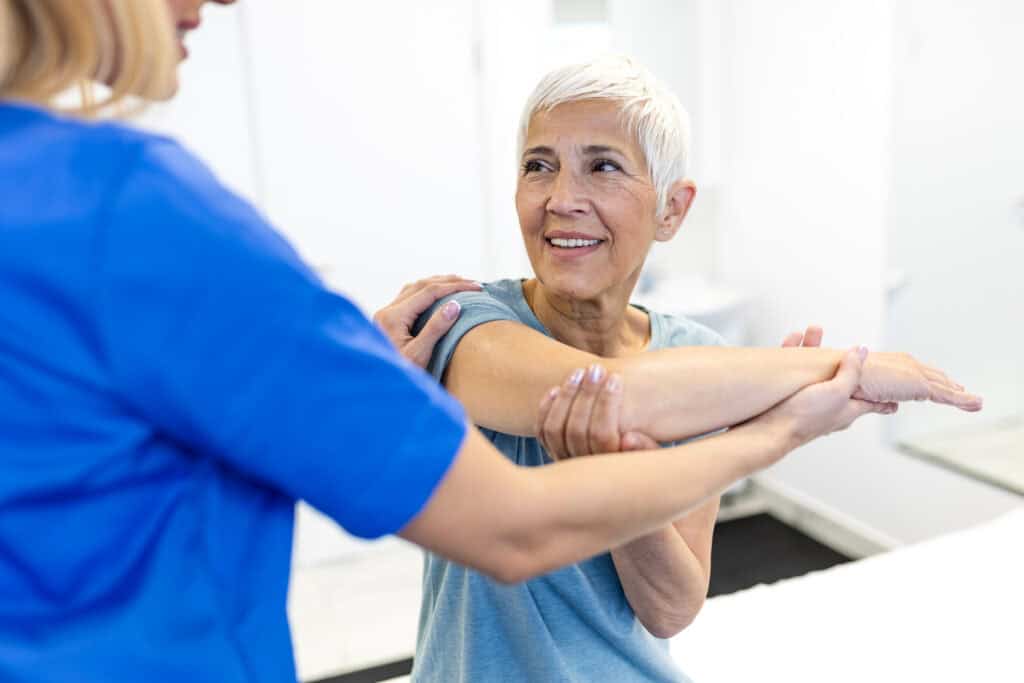
Physical therapy begins within the first few days of surgery — often the day after, while you are still in hospital. Early pendulum exercises, elbow and wrist movement, and gentle guided range of motion work help prevent stiffness and keep the joint mobile while the repair begins to heal.
Formal outpatient PT typically begins 1 to 2 weeks after surgery. Unlike rotator cuff repair, where the tendon needs significant protection before PT starts, shoulder replacement allows earlier supervised movement — though the pace and load are still carefully managed.
The arm is kept in a sling for the first 4 to 6 weeks. Within that window, your PT is guiding passive and assisted movement — the shoulder moves, but the muscles are not yet doing the heavy work.
Shoulder Replacement Recovery Phase by Phase
Shoulder replacement rehabilitation follows a structured progression. Each phase has a specific goal — and moving through them too quickly is one of the most common reasons patients end up with poor outcomes.
Phase 1 — Weeks 1 to 6: Protecting the Joint and Restoring Early Motion
The arm is in a sling. Pain and swelling are significant. The focus is on protecting the surgical repair while beginning very gentle passive and assisted range of motion work.
Pendulum exercises — small, gravity-assisted circles — are typically started within the first few days. Your PT will begin guided passive range of motion, moving the arm through safe ranges without asking the repaired muscles to activate. Elbow, wrist, and hand exercises keep the rest of the arm working and prevent stiffness from setting in downstream.
What you cannot do during this phase: use the arm to push yourself up, reach behind your back, lift anything, or use the arm across your body. These restrictions exist to protect the repair while it integrates — not as general caution.
Phase 2 — Weeks 6 to 12: Restoring Active Range of Motion
The sling comes off. Active assisted and then active range of motion work begins — meaning the shoulder muscles start doing more of the work to move the arm. The focus is on restoring full elevation, external rotation, and internal rotation without compensation or pain.
Manual therapy continues — joint mobilisation, soft tissue work, and scar tissue management. The goal by week 12 is to have comfortable active movement through most of the shoulder’s range and be performing daily activities like dressing, personal care, and light tasks below shoulder height without significant difficulty.
Strengthening is still limited at this stage. The joint and surrounding tissue need to move well before they can be loaded heavily.
Phase 3 — Weeks 12 to 20: Building Strength and Function
Progressive strengthening begins. Deltoid, rotator cuff (where intact), and scapular stabiliser work forms the foundation of this phase. Exercises are progressed systematically based on strength levels and what the shoulder tolerates.
For active adults and athletes in Southern California, sport-specific movement patterns are introduced toward the end of this phase — controlled overhead patterns for swimmers, tennis groundstroke mechanics, golf swing preparation. The shoulder is being rebuilt for what you actually want to do with it, not just generic functional milestones.
Two to three PT sessions per week plus a consistent home exercise program is standard. This phase separates the patients who get a good shoulder back from those who plateau at functional but not fully strong.
Phase 4 — Months 5 to 12: Return to Full Activity
The final phase is about returning to everything the shoulder needs to do in your life. Most patients are cleared for recreational activity by month four to six. Return to golf is typically possible around 4 to 6 months. Return to overhead sport and physically demanding work generally requires 9 to 12 months.
At Intecore, we do not discharge patients at the first functional milestone. We want the shoulder genuinely strong and capable — not just good enough. The difference matters when you are trying to do something that demands more than basic daily function.
How Long Is Shoulder Replacement Recovery?
Here is a realistic summary of shoulder replacement recovery times by milestone:
- Sling discontinued: 4 to 6 weeks
- Light daily activities (dressing, personal care): 6 to 8 weeks
- Driving (non-surgical arm or automatic transmission): 6 to 8 weeks with surgeon clearance
- Return to desk work or light office duties: 6 to 8 weeks
- Golf (chipping and putting): 4 to 6 months
- Recreational sport (non-overhead): 4 to 6 months
- Overhead sport or heavy physical work: 9 to 12 months
- Full recovery: 9 to 12 months for most patients
What Does Physical Therapy for Shoulder Replacement Actually Involve?
A well-designed shoulder replacement rehabilitation protocol is built around your specific procedure, your current strength and range of motion, and what you want to get back to. At Intecore, the core components look like this:
- Manual therapy: Hands-on joint mobilisation, soft tissue work, and scar tissue management to restore mobility and reduce stiffness.
- Passive and active range of motion: Carefully progressed movement work matched to your healing stage — passive first, active assisted, then fully active.
- Deltoid and rotator cuff strengthening: The muscles that power the new joint need to be rebuilt systematically. The approach differs between anatomic and reverse replacement.
- Scapular stabilisation: The shoulder blade is the platform the arm moves from. Without scapular strength and control, the mechanics of the new joint are compromised regardless of how good the surgery was.
- Functional and sport-specific training: In later phases, exercises are matched to the demands of your specific sport or activity — not just generic shoulder movements.
- Education and home program: What you do between sessions drives the outcome as much as what happens in the clinic. We build a home program you can realistically execute and progress it throughout recovery.
Shoulder Replacement Rehabilitation in Southern California
At Intecore Physical Therapy, we have helped patients through shoulder replacement rehabilitation across our clinics in Foothill Ranch, Aliso Viejo, and San Juan Capistrano. Whether you have had an anatomic total shoulder replacement or a reverse shoulder replacement, we build a program around your specific procedure, your current function, and where you want to get to.
If your surgery is scheduled and you want to prepare with prehab beforehand, or if you are already post-op and want to make sure your rehabilitation is on the right track, reach out to us now.
Fill out our quick inquiry form at intecorept.com/inquire or call us at (949) 597-2103. Let’s get your shoulder back.
Frequently Asked Questions
How long does shoulder replacement recovery take?
Most patients return to daily activities within 4 to 6 months. Full recovery — including return to overhead sport or heavy physical work — typically takes 9 to 12 months. Patients who follow their rehabilitation program consistently throughout recovery achieve the best long-term outcomes.
What is the difference between total and reverse shoulder replacement recovery?
Reverse shoulder replacement typically allows earlier active movement because the deltoid — rather than the rotator cuff — powers the shoulder. Anatomic total shoulder replacement requires more careful protection of the subscapularis muscle repair in the early weeks. Both procedures follow a similar overall timeline, but your rehabilitation protocol will be specifically designed for whichever procedure you had.
When can I drive after shoulder replacement surgery?
Most patients can drive at 6 to 8 weeks with surgeon clearance, provided they are off narcotic pain medication and can control the vehicle safely. If the surgery was on your non-dominant arm and you drive an automatic, return to driving is sometimes possible earlier. Always get explicit clearance from your surgeon before driving.
When can I play golf after shoulder replacement?
Chipping and putting are typically possible around 4 months. A full swing generally requires 6 months or more, depending on shoulder strength and range of motion at that stage. Your PT will guide a gradual return-to-golf progression rather than a calendar-based clearance — the shoulder tells you when it is ready, not the date.
Is shoulder replacement a hard recovery?
It is demanding, particularly in the first 6 weeks when the arm is in a sling and movement is restricted. Most patients find the emotional difficulty of the sling phase harder than the physical discomfort. Once PT gets going and the shoulder starts moving, the sense of progress builds quickly. Patients who commit to their rehabilitation consistently describe the recovery as challenging but manageable.
How many physical therapy sessions do I need after shoulder replacement?
Formal outpatient PT typically runs 3 to 4 months, two to three sessions per week — roughly 24 to 40 visits in total. Some patients need more depending on their starting strength, tear complexity, and return-to-sport goals. Insurance coverage varies by plan — check your benefits before starting or ask our team at Intecore to help you verify coverage.
What should I avoid doing after shoulder replacement surgery?
In the first 6 weeks: no lifting, no reaching behind the back, no pushing yourself up with the surgical arm, no reaching across the body, and no use of the arm above shoulder height. Many of these restrictions ease as you progress through rehabilitation. Your surgeon and PT will give you specific guidance based on your procedure and how healing is progressing.
Sources
AAOS — Shoulder Joint Replacement https://orthoinfo.aaos.org/en/treatment/shoulder-joint-replacement/
JOSPT — Rehabilitation After Total Shoulder Arthroplasty https://www.jospt.org/doi/10.2519/jospt.2016.0507
NIH — Reverse vs Anatomic Shoulder Arthroplasty Outcomes https://pubmed.ncbi.nlm.nih.gov/28552585/
Mayo Clinic — Shoulder Replacement https://www.mayoclinic.org/tests-procedures/shoulder-replacement/about/pac-20385042
APTA — Shoulder Clinical Practice Guidelines https://www.apta.org/patient-care/evidence-based-practice-resources/cpg/shoulder-pain

- Shoulder Replacement Recovery: A Phase-by-Phase Guide to Getting Your Shoulder Back - April 2, 2026
- Rotator Cuff Surgery Recovery: What to Expect Week by Week (And How PT Gets You Back to Full Strength) - March 31, 2026
- Should You Do Physical Therapy Before Knee Surgery? Here’s What the Research Says - March 31, 2026
You Might Also Like...
-
 June 7, 2016
 -
 October 21, 2025
 -
 April 7, 2015