Full knee replacement recovery takes 3 to 6 months for most daily activities, and up to 12 months to feel completely back to normal. Physical therapy typically starts within 24 hours of surgery and continues for 6 to 8 weeks of formal outpatient care. The patients who recover fastest are the ones who commit to their PT program and stay consistent, even when it feels hard.
If you just had knee replacement surgery, or you’re getting ready for it, you probably have a lot of questions running through your head.
When will the pain go away? When can I drive again? How long until I can walk normally? And how much does physical therapy actually matter?
These are exactly the right questions to be asking. And I want to give you honest answers — not the vague “it depends on the patient” response you might have gotten elsewhere.
I’ve worked with hundreds of patients through knee replacement recovery here in Southern California.
Some came in nervous, having been told their recovery would be long and painful. Most of them were back to the activities they loved within a few months — walking the trails, keeping up with grandkids, getting back to the gym.
One of our patients had hip and shoulder replacements over the years and kept coming back to Intecore every single time. Another came in after four years of back problems following surgery, worried he’d never be active again. He’s now running, swimming, and surfing. These outcomes don’t happen by accident. They happen because of consistent, well-guided rehabilitation.
Here’s what knee replacement recovery actually looks like, week by week.
Table of Contents
What Is Knee Replacement Surgery, and Why Does Recovery Take Time?
A total knee replacement — also called total knee arthroplasty — replaces the damaged surfaces of your knee joint with metal and plastic components. It sounds dramatic, and in some ways it is. Your surgeon is removing bone and tissue that your body has relied on for decades.
That’s why recovery isn’t something you rush. The joint needs time to heal, the surrounding muscles need to be retrained, and your nervous system needs to relearn how to move that knee safely. Physical therapy accelerates every one of those processes.
A partial knee replacement (unicompartmental) typically has a faster recovery — often 6 to 10 weeks before patients feel significantly better — because less of the joint is replaced and more of the natural tissue is preserved.
When Does Physical Therapy Start After Knee Replacement?
This surprises a lot of people: physical therapy starts the same day as surgery or the morning after. While you’re still in the hospital, a PT will help you stand, take your first steps, and begin basic range-of-motion work.
Early movement is not optional — it’s essential. It prevents dangerous blood clots, reduces swelling faster, and starts the process of retraining your muscles. The old “rest and recover” approach has been replaced by what we now know works: move early, move often, and move with guidance.
Once you’re home, most patients transition to outpatient physical therapy within the first one to two weeks. That’s where the real work begins.
Knee Replacement Recovery Week by Week: A Realistic Timeline
Every patient is different, but here is what a typical recovery looks like. Use this as a guide, not a strict schedule.
Weeks 1 to 2: Managing Pain and Getting Moving
The first two weeks are about managing pain and swelling, protecting the surgical site, and starting to move the knee through a safe range of motion. You will likely need a walker or crutches. Sleep is disrupted. This is the hardest stretch for most people — not because they aren’t making progress, but because the progress feels invisible.
PT goals at this stage include getting the knee to at least 90 degrees of flexion, achieving full extension (straightening), and beginning basic strengthening exercises like quad sets and heel slides.
Weeks 3 to 6: Building Strength and Confidence
By week three, most patients are moving more independently. Pain is still present but more manageable. You may be walking with a cane or without any assistive device by week four to six. This is when outpatient PT becomes central to your progress.
At Intecore, we focus heavily on building quad strength at this stage — because quad weakness is the number one predictor of a slow recovery. We also work on balance, gait mechanics, and stair climbing. Your PT will push you, but always at a pace your body can handle.
Weeks 6 to 12: Returning to Daily Life
This is the phase where most patients start to feel like themselves again. Walking longer distances, sleeping better, driving (usually cleared around 4 to 6 weeks for the right knee, sooner for the left). Many patients complete their formal PT program around the 8-week mark, though ongoing home exercises remain important.
By week 12, most patients have achieved 110 to 120 degrees of knee flexion — enough for most daily activities including walking, light hiking, and stairs.
Months 3 to 6: Getting Back to What You Love
The final stretch of active recovery. Swelling continues to decrease. Energy improves. Patients who have stayed consistent with their exercises report feeling significantly stronger each month. Low-impact activities like swimming, cycling, and golf are typically cleared during this period.
Some patients feel fully recovered by month three. Others — particularly older adults or those who had significant pre-surgical deconditioning — take closer to six months. Both are normal.
How Long Does Physical Therapy Last After Knee Replacement?
Formal outpatient physical therapy typically runs 6 to 8 weeks, with sessions two to three times per week. That’s roughly 12 to 24 visits in total. Medicare and most insurance plans cover outpatient PT after knee replacement — though coverage limits and copays vary, so it’s worth checking with your provider.
Beyond formal PT, your home exercise program matters just as much. The patients who do their exercises consistently between sessions recover significantly faster than those who only do the work in the clinic.
Does Age Affect Knee Replacement Recovery Time?
This is one of the most common questions we get — especially from patients in their 60s, 70s, and 80s who are worried that age will hold them back.
Age does play a role, but it’s not the deciding factor most people think it is. What matters more is your overall fitness and muscle strength going into surgery, your commitment to PT during recovery, the absence of other significant health conditions, and your mental attitude and consistency.
A motivated 72-year-old who does the work will almost always outperform a sedentary 58-year-old who skips their exercises. We see this regularly at our clinics in Foothill Ranch, Aliso Viejo, and San Juan Capistrano.
One thing that does help significantly, regardless of age, is pre-surgical physical therapy — also called pre-habilitation. Strengthening the muscles around your knee before surgery gives your body a better foundation to recover from. Research consistently shows that patients who do pre-op PT recover faster and achieve better outcomes.
What Makes Physical Therapy After Knee Replacement Actually Work?
Not all PT is created equal. Here is what separates effective post-surgical rehabilitation from going through the motions.
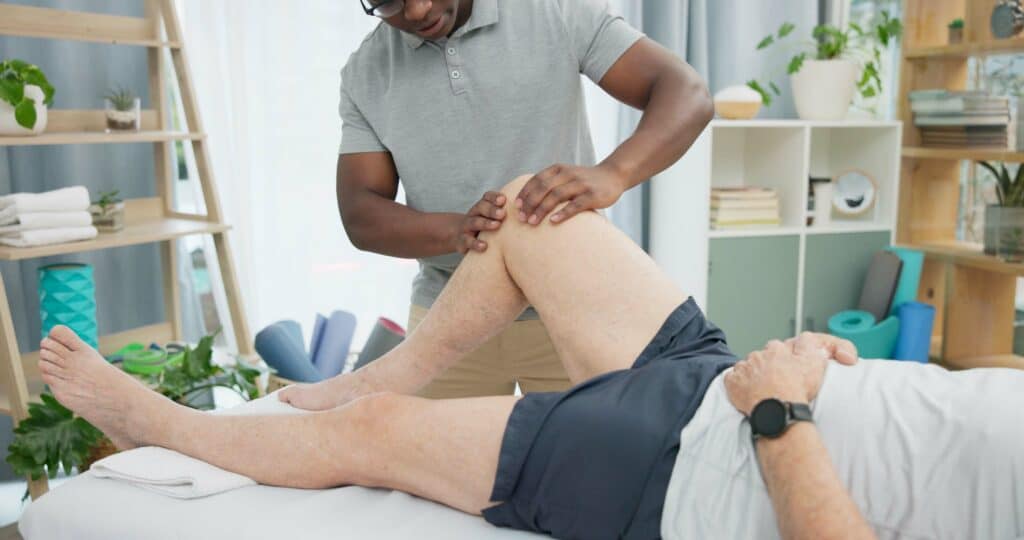
- Hands-on manual therapy: Soft tissue work, joint mobilization, and scar tissue management help restore movement and reduce stiffness more effectively than exercise alone.
- Progressive strengthening: Your quad, glute, and hip muscles have to be rebuilt systematically. Too aggressive too soon causes setbacks. Too conservative leaves patients weaker than they need to be.
- Gait retraining: Many patients develop a limp or compensatory movement patterns after surgery. Good PT corrects these early before they become habits.
- Education and home exercise: What you do between sessions matters as much as what happens in the clinic.
- A care team that communicates with your surgeon: Especially in the early weeks, your PT and surgeon should be aligned on your progress and your program.
Getting Post-Surgical Knee PT Right in Southern California
At Intecore Physical Therapy, post-surgical rehabilitation is one of the things we do best. Our team in Foothill Ranch, Aliso Viejo, and San Juan Capistrano has helped patients recover from total and partial knee replacements, ACL reconstructions, rotator cuff repairs, spinal fusions, and more.
We know what recovery is supposed to look like at each stage — and we know how to help when things stall. Whether you’re preparing for surgery and want to get ahead of it, or you’re already post-op and want to make sure your rehab is on track, we’re here for you.
Fill out our quick inquiry form at intecorept.com/inquire or call us at (949) 597-2103. We’ll listen to where you are in your recovery and tell you exactly how we can help.
Frequently Asked Questions
What is the full recovery time for a knee replacement?
Most patients are back to daily activities within 3 to 6 months. Full recovery — where the knee feels close to normal with minimal swelling and good strength — typically takes 9 to 12 months. That said, many patients feel dramatically better by the 3-month mark.
When can I drive after knee replacement surgery?
For a right knee replacement, most surgeons clear driving around 4 to 6 weeks, once you can bend and straighten your knee enough to brake safely and are off narcotic pain medication. A left knee replacement generally allows a faster return to driving, often 2 to 3 weeks, if you drive an automatic.
How many physical therapy sessions do you need after knee replacement?
Most outpatient PT programs run 12 to 24 sessions over 6 to 8 weeks. Some patients need more, particularly if they are making slower progress or had significant weakness before surgery. Medicare and most insurance plans cover post-surgical PT — check your specific plan for session limits.
Can you do too much physical therapy after knee replacement?
Yes. Overworking the joint in the early weeks can cause increased swelling and delayed healing. A good PT will pace your program appropriately — pushing hard enough to make progress, but not so hard that your knee is swollen and painful for days after a session. If you’re consistently worse after PT, tell your therapist.
Is it normal for my knee to still hurt at 6 weeks post-op?
Yes, completely normal. At 6 weeks, most patients still have some pain and swelling — especially after activity. This is not a sign that something is wrong. The knee is still healing internally long after the incision looks fine on the outside. Consistent PT and following your home exercise program are the best things you can do during this stage.
Does pre-surgical physical therapy actually help knee replacement recovery?
Yes — research backs this up clearly. Patients who complete pre-operative PT (prehabilitation) before total knee replacement consistently recover faster, achieve better range of motion earlier, and often require less post-operative pain medication. If you’re scheduled for surgery and haven’t started PT yet, it’s not too late.
What is a partial knee replacement recovery timeline?
Partial knee replacement recovery is generally faster than total knee replacement. Most patients are walking without aids by 3 to 4 weeks, driving by 4 to 6 weeks, and back to most activities by 6 to 10 weeks. Formal PT still plays an important role and typically runs 4 to 6 weeks.
Sources
American Academy of Orthopaedic Surgeons (AAOS) — Total Knee Replacement Recovery Guidelines
Journal of Orthopaedic & Sports Physical Therapy (JOSPT) — Post-Surgical Rehabilitation Protocols
Mayo Clinic — Knee Replacement Surgery Overview
American Physical Therapy Association (APTA) — Clinical Practice Guidelines for Knee Osteoarthritis

- Hip and Leg Pain Solutions | Relief for Radiating Discomfort - June 26, 2026
- Managing Hip and Leg Pain at Night: A Guide to Better Sleep - May 14, 2026
- Have you been told you need surgery? - April 21, 2026